



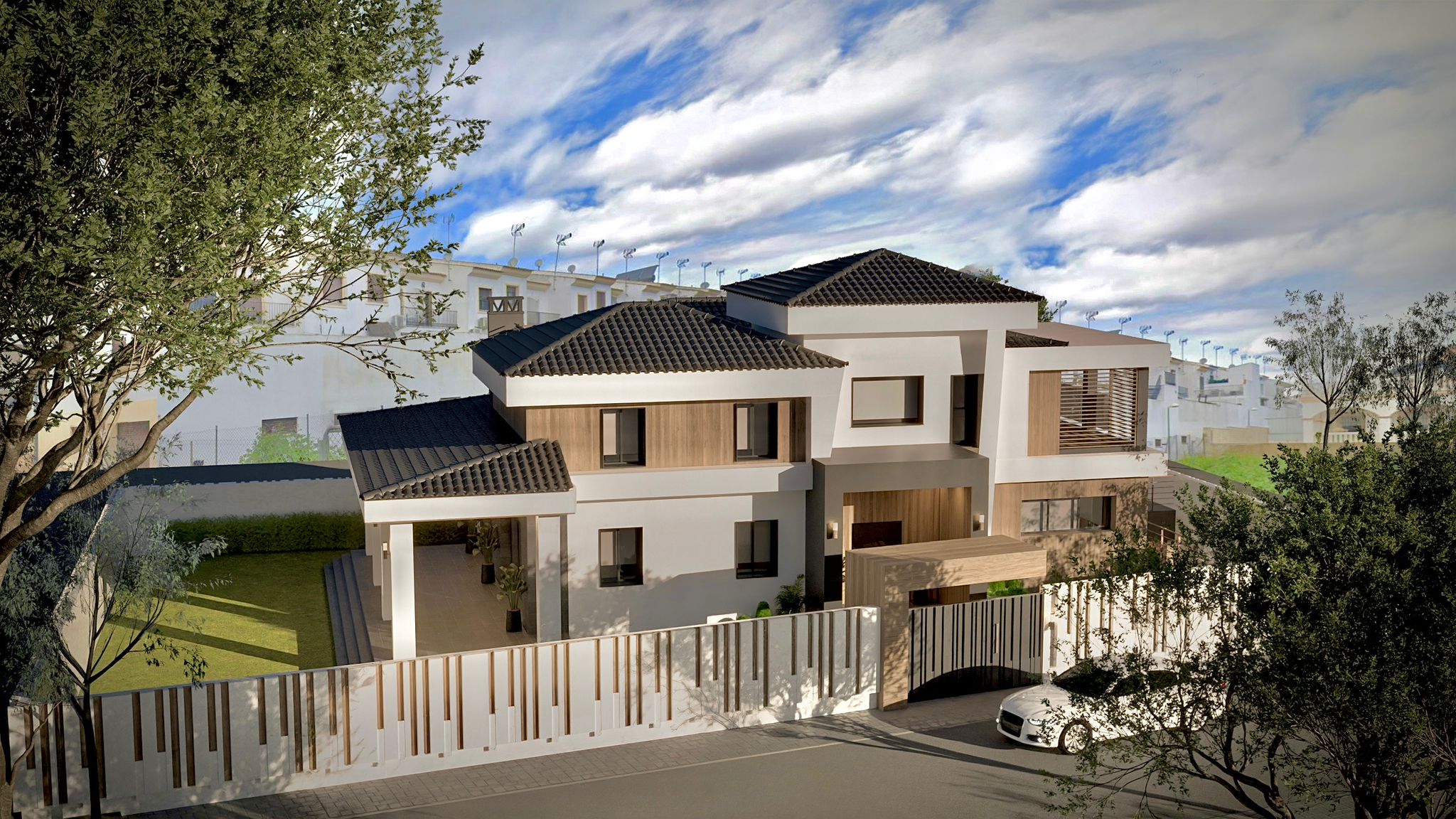
Choosing an exterior material simply because we like how it looks in a photograph or on an existing building can be a starting point. However, it should not be the only factor if we are looking for qualities such as durability.
Exterior materials are exposed to all kinds of weather conditions: sun, rain, wind, humidity and changes in temperature. If the property is close to the sea, they must also withstand an environment that is particularly aggressive towards certain materials and components.
When we design a home at our Huelva-based studio, Miguel TuArquitectura, we do not treat a façade material as an isolated decision. We need to analyse and anticipate, as far as possible, how it will perform and how it will fit into the overall architectural design. There is also another essential consideration: how it will age in its particular setting.
A modern façade should work today and still work ten or twenty years from now.
These are some of the questions I consider important before choosing the exterior materials for a home.
1. Where is the property located?
Location is crucial.
I would not necessarily choose the same solution for a home in inland Huelva as I would for a property in Punta Umbría, El Rompido or anywhere else close to the Atlantic.
Huelva receives intense sunlight and is strongly influenced by the ocean. In coastal areas, humidity and salty air must also be taken into account. These conditions affect the performance and ageing of cladding, window and door frames, metal components, joints and fixings.
Something similar happens on the other side of the border. In the Algarve and other areas along the Portuguese coast, the combination of sunlight, humidity, wind and salinity requires particular attention to the choice of materials and, above all, to the way they are installed and detailed.
The question “Which material do you like?” should therefore be followed immediately by another: where are we going to use it?
2. How will it perform in the sun?
Light is one of the aspects that interests me most when I design a home. However, the same light that makes a particular architectural concept possible should also influence the choice of materials.
A façade in Huelva will be exposed to intense sunlight for many hours and on many days of the year. We therefore need to consider how its finishes, colours and different components will respond.
This goes beyond whether a material might lose its colour. Its resistance to radiation, thermal expansion, the performance of its joints and its compatibility with other materials should also be assessed.
In this respect, orientation does not merely determine where we place a window. It can also influence how we construct the exterior identity of the house.
3. Are we close to the sea?
If the answer is yes, the issue deserves specific consideration.
A marine environment can accelerate corrosion and deterioration in certain materials. This may affect exposed metal components, fixings and some finishes, for example.
Humidity and salts also influence the selection and installation of exterior cladding.
For a house close to the coast, we need to examine the type of fixings to be used, the treatment applied to metal components, the specifications of the window and door frames and how they are expected to perform over time. We must also determine whether the proposed façade system offers a suitable response to humidity.
These decisions will prove decisive as the years pass.
4. How much maintenance are we prepared to undertake?
I find this question particularly useful because not everyone is prepared to make a significant financial outlay on the future maintenance of their home.
Some natural materials evolve over time, and this transformation is part of their beauty. Others require periodic treatment or maintenance to retain their original appearance.
Some options may prove more costly than others, so these factors should be considered before the project begins.
If we use timber for certain exterior elements, for example, we need to examine the species, treatment, exposure and maintenance it will require.
If we opt for continuous render systems, stone, ceramic materials, industrialised systems or metal components, we must also assess their performance and suitability for the project.
Ultimately, there is no automatic answer to the question “What is the best material for a façade?”
There is a suitable material for that particular home, in that particular place, with that particular design and for the people who will live there.
5. How do the materials relate to one another?
A contemporary façade can acquire considerable character through the combination of very few materials.
Personally, I prefer to work with a restrained palette of different materials that harmonise well, rather than adding elements simply to create an impact.
Light-coloured surfaces, timber or other warm finishes, glass, stone, metal elements… The aim should not be to accumulate materials for greater effect, but to establish a coherent relationship between those selected.
This coherence is not purely aesthetic.
Materials expand at different rates, absorb water differently and have their own thermal behaviour. The junctions between them must therefore be properly designed.
It is precisely at these points that design and technical detailing become inseparable.
6. How do we want the façade to age?
This is one of the most relevant questions when choosing the right materials for your future home.
If ageing has not been considered, the image you saw in a visualisation could end up looking very different from the reality of your home over time. This is an essential factor to bear in mind.
A house, like any building, should be imagined both on the day it is completed and many years later. Some materials develop an attractive patina, while the deterioration of others can clearly detract from the overall appearance.
This summer, I had the opportunity to observe many of the details I am describing at the Galician Centre for Contemporary Art (CGAC), which I recommend visiting if you travel to Santiago de Compostela. It was designed by Álvaro Siza Vieira.
The building in the Galician capital opened in 1993 and is considered a masterpiece. Shortly after its completion, the chosen granite underwent such a significant change that the renowned Portuguese architect expressed his surprise and called for technical specialists to assess the best solution, according to an article published by El País in 1997.
Not everything can be predicted, of course. Even so, choosing well means anticipating the effects of time as far as possible.
A façade should therefore do more than look attractive when the building work is completed. Our aim should be for it to age in the way we would like it to and sometimes even improve on its original appearance.
7. Is the material serving the architecture, or are we designing around the material?
This final question sums up my approach to the process quite well.
Sometimes, a striking material can tempt us to think first about where it might be used.
I try to do precisely the opposite.
The project comes first: the people who will live in the house, the plot, its orientation, proportions, light, spaces and the relationship between inside and outside.
The materials come afterwards.
Their role is to reinforce the architecture.
We might use contrasts between white surfaces and warmer elements. Certain types of cladding may also help us emphasise volumes, planes or distinctive features of the façade.
In every case, the material then has a clear reason for being there.
That purpose can be felt in the harmony of the whole.
Modern façades: far more than an aesthetic choice
When someone is looking for ideas for a modern façade, it is natural to begin by looking at images. I also observe architecture constantly, wherever I go. I love travelling and find inspiration in many places.
However, between an image that attracts us and a well-designed exterior lies a process of technical and creative decision-making that is not always visible.
In Huelva, along the province’s coastline and in southern Portugal, the climate makes the issues discussed above particularly important.
Spanish building regulations also link façade waterproofing requirements to local wind exposure and rainfall. They address aspects such as vapour permeability, the capacity to accommodate movement in the substrate and resistance to cracking.
For this reason, I do not regard the choice of materials as the stage when we simply decide how we want the house to look.
It involves far more than that.
Materials shape the appearance of a home and make a decisive contribution to its comfort, maintenance requirements, durability and relationship with its surroundings.
When all these decisions have been made carefully rather than impulsively, it is unlikely that anyone will ask, several years later, why we chose that particular material instead of another.
They will simply feel that it is an integral part of the space and that it was always meant to be there.